¶ Thargoid Special Attacks
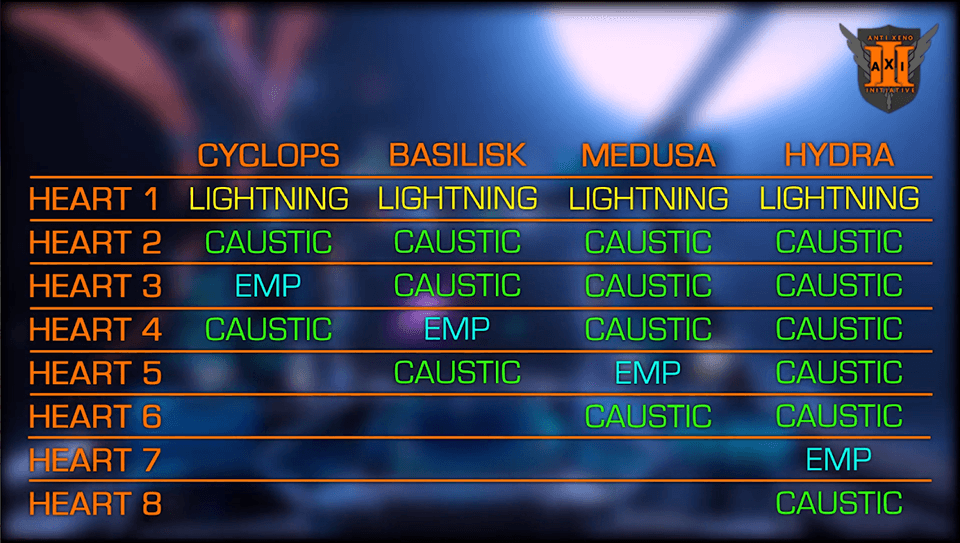
Thargoids employ a variety of special attacks apart from their main cannons. Interceptor combat variants use various attacks after one of their hearts is destroyed, while Orthrus Interceptors and Glaive Hunters employ other special attacks at will.
For detailed breakdown of Thargoid Attack values and other stats, visit our Thargoid Spec Sheet.
¶ Lightning
After the destruction of the first heart, Interceptors will enter a “lightning-chase phase”. During this time, lasting 30-40 seconds, they will attempt to chase you down to catch you with this attack.
Being caught within 700-800 m will have the lightning attach to your ship, rendering you immobile and knocking out one of your systems at random. Although your engines may still somewhat function, for a small period of time after the attack, you will struggle to build up speed as your ship will be under a braking effect, FA-OFF does not cancel out this effect.
The Lightning attack has very low armor penetration, meaning its damage to hull is usually not devastating by itself. However it will do massive damage to shields and significant module damage.
Another indirect danger of lightning is the swarm; which will often intersect, agitate on, and missile your ship while immobile.
Interceptors also unlock this ability to be used at any time during the rest of the fight following the destruction of the first heart and if you come close enough, although they require a longer charge time than during the “lightning-chase” after the first heart.
The Hunter Glaive has a special variant of lightning, which will recharge its shields when it connects with a ship.
¶ Caustic Missiles
After the second heart is desroyed, the interceptor will use caustic missiles, which are slow-moving (~350 m/s) missiles that applies a permanent damage over time (DoT) effect on your hull. Caustic damage can be removed by bringing your heat above 180% for several seconds, or to 250% for instant removal, or by using a decontamination limpet. To achieve these temperatures, you can use SCBs, firing gauss cannons, or if you can afford to drop shields, using silent running.
Ensure you have sufficient heatsinks/power in sys to fire two heatsinks to quickly bring your heat below 100%. During this time, the interceptor will not miss. Alternatively, caustic damage will be removed upon docking at a station.
The launch of caustic missiles can be entirely avoided by keeping a low temperature (below 20%) or being outside of 3km. Decontamination limpets can also be used to remove caustic, however note these can be the slowest method and require limpets in cargo.
Glaive Hunters will also fire weak caustic missiles at regular intervals once their hull has been damaged enough.
¶ Shutdown Pulse
On the second-to-last heart destruction, the interceptor will attempt to use EMP (shut-down field), which will render your ship inoperable for 30 seconds or so (your wing beacon will also turn off because of this).
You can avoid triggering the EMP field by being outside of 3 km before it attempts to initiate the attack, or by keeping a low temperature (below 20%). You cannot avoid the EMP once the attack has been queued unless you are beyond 10 km, stay in FA-off and boost away from the swarm/interceptor before the attack hits if you are not carrying a shutdown field neutralizer.
Interceptors will also fire a shuitdown pulse when entering an AXCZ, or after a nebula-hyperdiction.
¶ Anti-Guardian Field
The Orthrus Interceptor and Hunter Glaive employ a special Anti-Guardian field, which will slowly degrade the guardian modules of any ships within a large radius of them. Since these fields are actve as long as the vessel is in combat, using un-protected guardian weaponry against these vessels is ill-advised unless properly prepared.