¶ Introduction
We generally recommend CMDRs attain at least the Serpent’s Nemesis rank (Medusa solo) before they focus on learning any advanced techniques involved in speedrunning.
Stunlocking up until Basilisks, under correct guidance, is not too difficult to achieve and is an efficient method to farm Credits in Elite.
However, gaining flying experience and learning Interceptor Mechanics through regular AX combat first, is better for personal AX progession.
¶ Speedrunning Ranks
There are two ranks associated with speed kills: Myrmidon and Caduceus’ Glint
Submissions for any of our speedrun ranks are done via the /speedrun command in our #speedrunning discord-channel.
All approved speedruns go into our database. The 10 fastest runs in each division are displayed on our Leaderboards on the website.
Myrmidon is the speedrunning rank in our regular challenge-rank lineup. Whereas Vanguard requires you to do a complex or off-meta kill, but gives you no time limit, Myrmidon allows you to use a meta ship, but gives you a strict time limit.
The rank can be achieved by destroying a Medusa Interceptor under the following time and ship requirements:
- View current Myrmidon Requirements here.
Caduceus’ glint, or glint for short, is the top rank for speedrunning kills. It is a “competitive” rank - as in, you can lose this rank.
Glint is awarded to each holder of the fastest small/medium/large ship kill on Basilisk, Medusa, and Hydra. (Note: Cyclops does NOT award a Glint rank.)
Feeling skilled? Try to see if you can collect them golden rings …
¶ Speedrunning Theory
Speedrunning is about killing a Thargoid in the shortest amount possible, without resorting to bugs or unintended mechanics (e.g., “gibbing”).
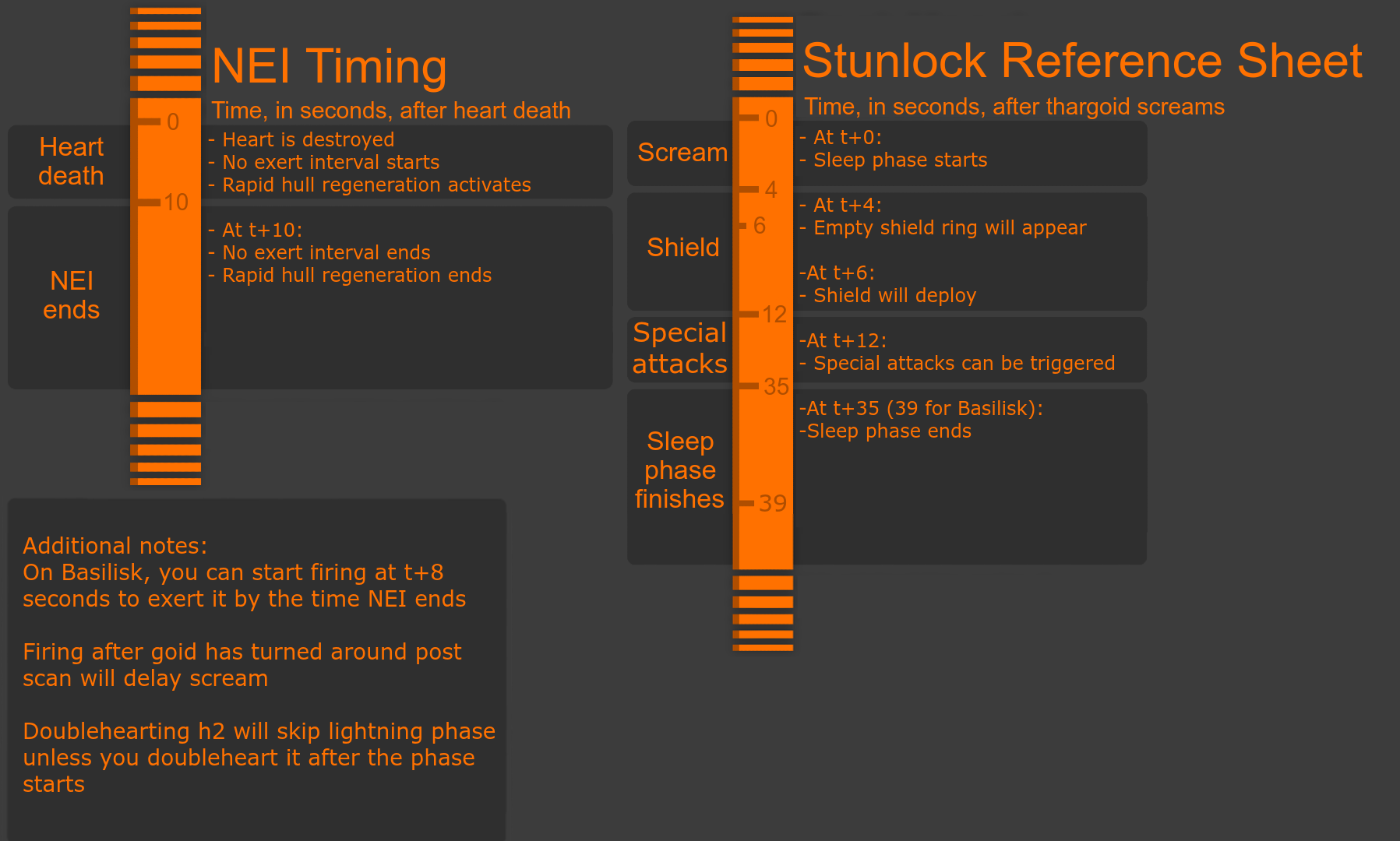
In order to get started, the first thing you’ll want to understand is the detailed behavior of Goid AI upon heart distruction. Understanding this is critical to avoid triggering “panic shields”:
¶ NEI - Non Exert Interval
A time during which a heart can not be exerted. After a heart is destroyed the interceptor can not be exerted again for 10 seconds, even with overwhelming damage.
If overwhelming damage to reach the exert treshhold was done during this time period, the next interceptor heart will immedietely exert at the end of the NEI, assuming the treshhold is still met at that point.
¶ Sleep Phase
Whenever an interceptor’s heart is destroyed it will enter a 35-40 second sleep phase. The exact time differs between Variants. (Except after the first heart, here the interceptor will enter the lightning phase unless the second heart is destroyed before activation.)
The interceptor will try to position itself exactly 1km away from you, when you are in its vicinity - moving backwards or forwards as required.
During the sleep phase the interceptor is looking for a target for its caustic missile or shutdown-field special attack.
Avoiding a target-lock will let the sleep phase run its coursek.
¶ Speedrunning Techniques
¶ Shield Ramming
Shield ramming can be used in any type of speedrun whether it’s cold orbiting or stunlocking. Ramming an interceptor’s shield usually triggers a special attack as a result of violating minimum range for:
-
Lightning if interceptor is active;
-
Caustic missiles if interceptor is in sleep phase;
-
Shutdown field if it’s second to last sleep phase (along with caustic missiles).
Let’s break down the most common shieldrams:
¶ Shield after first heart
After destroying the first heart the interceptor initiates a lightning chase, which:
-
Encourages us to ram its shield;
-
Blocks the interceptor’s ability to deploy new panic shields regardless of how fast this shield will get destroyed.
Lightning does low amounts of hull damage because of low Armour-Pen. A ram trades off ship hull for instant interceptor-shield removal.
To ram off the shield sucessfully you should:
-
Back off a little after destroying the interceptors first heart;
-
Line up and boost into the interceptor, so you ram the shield before the lightning-zap kills your momentum.
Usually lightning duration is enough to exert and destroy the next heart after a successful shield-ram.
¶ Shield after all other hearts
As we already know, after every heart destruction except the first one, the interceptor falls into sleep phase, meanwhile deploying a new shield. If you want to ram this shield off, you should expect interrupting sleep phase because of violating minimum detection range (roughly 700m).
And that’s where it’s getting more complicated, because without full knowledge on how panic shields are triggered, you will end up causing exactly that.
To successfully ram the shield off you need:
-
Count to 7 (every second) from the moment when shield got deployed (cue: green dots and lights along with “exhale” noise)
-
Trigger caustic missiles and wait until ALL of them are released (cue: after releasing all caustic missiles, interceptor petals stop glowing bright red)
-
Line up for the ram and boost
Without those steps one may end up triggering panic shield either due to overwhelming shield damage or countermeasure deployment.
In case of shieldramming in second to last sleep phase, you should expect triggering shutdown field which implies that you have shutdown field neutralizer equipped.
¶ Stunlocking
In AX, stunlocking refers to a method of killing interceptors by dealing overwhelming damage during their Sleep phase to start the next one.
By repeatedly forcing the interceptor from one sleep phase to the next it is possible to keep it from moving. Destroy the interceptors heart while the sleep phase from the previous one is still ongoing and you can stun it in this continuous loop till death.
This is convenient since it is possible to avoid an open-fielded fight with the interceptor that way. It allows for more specialised builds, less focused on manoeuvrability and more focused on raw damage output.
In order to not wake the interceptor up it is necessary to avoid detection. Interceptors can detect a ship by heat; ~ >20%, or by proximity when entering the minimum detection threshhold of roughly 700m. These values are rules of thumb and will slightly differ by ship.
¶ Silent Running Lock
Stunlocking while silent running will mean you can freely fire away your weapons at maximum possible output. Silent Running closes your heatvents, essentially making your ship appear as 0% heat output to onlookers, including interceptors.
SR is the easiest way to avoid detection during the fight, but firing weapons under silent running comes with constant overheating, causing:
- Hull damage over time
- Module damage over time
¶ Cold Locking
To cold lock you need to deal the damage required for stunlocking while also maintaining a temperature of less than 20% using heatsinks (20% is a rule of thumb and differs by ship).
Cold Locking becomes relevant when stunlocking high tier Interceptors. Their survivability drags out the fight too long to get away with the accumulative overheating-damage of silent running.
¶ Doublehearting
Destroying the next heart and skipping the shield phase of the previous heart.
¶ “Impossible Shot” or “Lightning skip”
Destroying the second heart before the first shield comes up and therefore skipping the lightning phase.
The name “Impossible Shot” is a keepsake of the days when gauss still dominated the speedrunning scene (as better options were not available yet). Back then you had a 2 second window of opportunity for this, and taking the 1.25s charge up time of gauss into account, this was indeed a difficult thing to pull off.
¶ Speedrunning Builds
View the Speedrun Builds page for a collection of recommended builds specialised for speedruns.
¶ Speedrunning Guides
A comprehensive guide on NHSS loop Baslisk farming: